
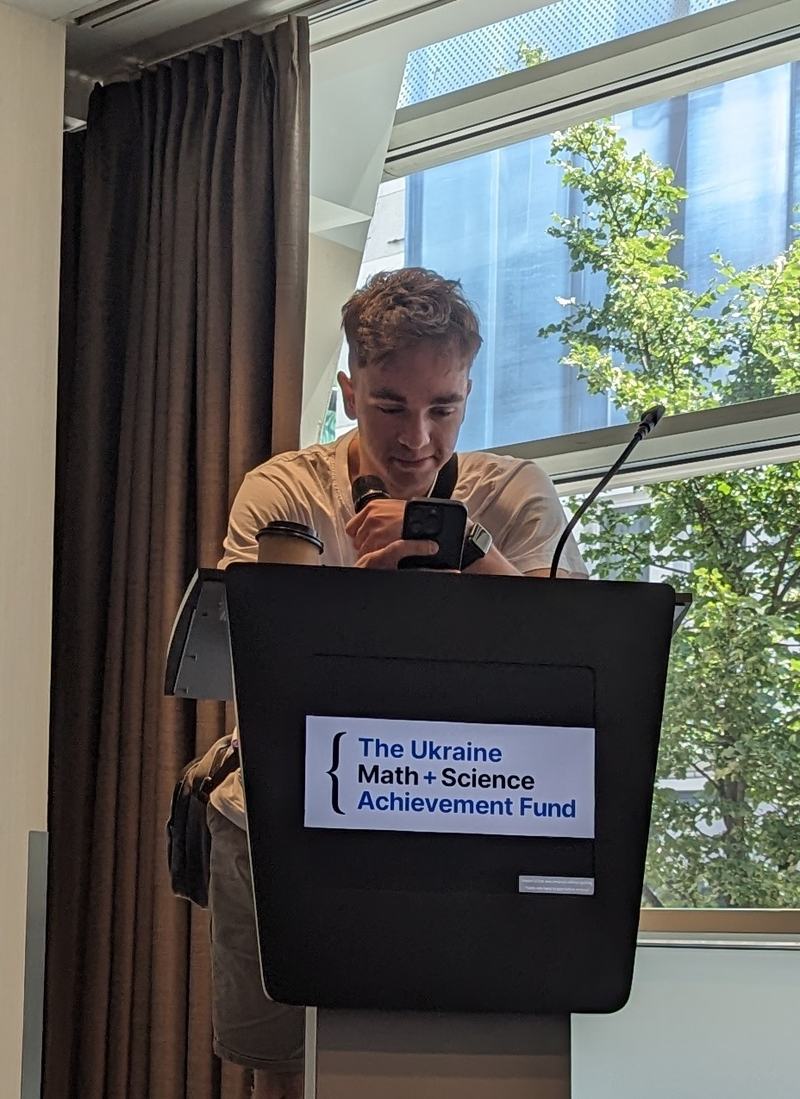
Roman Yanushevskyi
“The most interesting are difficult problems when I am not sure that I will be able to solve it. Even if I sit on it for half an hour, it is not a fact that I will solve it - then the interest only grows.”Database →
- Gold medalist of the International Olympiad in Informatics 2022.
- The best Ukrainian (7th place) at International Olympiads in Informatics since 2006.
When exactly did your interest in informatics and programming appear? Why these subjects in particular?
Living in an information space, it is hard not to come across the idea of the programmer. They are written about in the news, films are made about them, they are presented as geniuses of our time whose deeds win the admiration of those around them. Watching the rapid development of technology and the way history is being made around us, I think anyone would want to work out how it all functions and what is really going on on the other side of the screen.
How did you find out about the informatics olympiads? Do you remember your first olympiad?
Students at my lyceum took part actively in various olympiads, so being in that environment I could hardly fail to hear about them. At first I was not very interested, perhaps because for a long time it seemed rather boring, but thanks to the school and the people around me I did decide to go along to that sort of event.
My first olympiad was the district olympiad of 2019, which I went to because my friends were going. I liked the format straight away. A lyceum student's weekdays did not usually offer many chances to leave the house other than for school, and the olympiads were a good excuse to get out and meet colleagues (before Covid, of course).
And then at the city olympiad of 2020 I got a fairly good result, unexpectedly for myself. That is when the thought crossed my mind that if I had got a decent result while relatively unprepared, then with a little more effort I could go further still.
How did you prepare for the olympiads, how much time did it take? What did your preparation and your goal look like?
I would not say I had a “goal” at the time. I did not really believe I would even reach the Ukrainian Olympiad. The thing is that in Ukraine people start doing olympiads earlier than I did, and usually those who do well in 11th grade already have certain achievements at my age then. So I saw programming more as a hobby, convincing myself it was not a waste of time on the grounds that (at least at that point) companies such as Google, Facebook and Amazon set puzzles at interview of a similar kind to the ones set at olympiads.
Which matters more to you — taking part or winning? How do you take defeats?
I will admit honestly that I never sorted my performances into those categories. Walking out of the competition hall, all I was aware of was a storm of thoughts in my head summing up the competition and drawing conclusions about what my strategy should have been to score more points. That is because situations repeat themselves relatively often, and next time, in similar circumstances, my experience and analysis would find a use.
I did not take the score I got at an olympiad very emotionally, since for me it is nothing more than the sum of my preparation, for which I am responsible myself. A competition is like training, but with the chance to test yourself and your strategy in “field” conditions: with a real timer and living rivals beside you. Of course there is always an element of chance, and sometimes you can simply be unlucky. But I never looked for anyone to blame for that other than myself, because a truly ideal strategy, in my view, has to be equal to every case.
That unemotional approach to the result turned defeats into nothing more, for me, than a sign that certain points had to be worked on and not repeated. But the negative side of that approach was probably that I did not feel much joy at a good performance either: a good result is only a sign that you should carry on in the same direction.
Do you have your own formula for success, or a motto?
I do not much believe there is a universal formula for success, and I cannot guarantee that doing what I did is a hundred-per-cent route to victory.
Thinking globally, the people who did programming but did not achieve striking results are not merely many — there are orders of magnitude more of them than of those who achieved something. But nobody knows about them. They are not given awards, they are not interviewed and nobody asks them for their “formula for success”. If luck had not fallen my way at some stage and I had not reached the International Olympiad, this conversation with me would not be happening — just as it is not happening with the thousands of students who trained as hard as I did.
So it is worth taking into account the stories of all people, including stories of failure. There are far more of those than there are success stories, and believe me, you can learn much more from mistakes.
Which competition was the most important and instructive for you? Why?
From the point of view of a career, the International Olympiad, of course, since it is the most prestigious competition I took part in; it was both the outcome and the summing-up of my preparation. An olympiad competitor is usually remembered for their best performance, but of course there were olympiads I did not do so well at.
As I have said, failures sometimes hold more useful information than successes, and in that sense the most useful for me was round 1 of IZHO 2022 (the International Zhautykov Olympiad), which unexpectedly for me — and for others — I did relatively badly at. But thanks to that performance I discovered a flaw in my strategy that would sooner or later have brought it down. If I had been lucky and done well at that olympiad, I might have thought my strategy was perfect and needed no changes. But any inaccuracy or sub-optimality makes itself known one way or another and can lead to a fatal collapse. So it is far better for such a collapse to happen at an olympiad nobody now remembers than at something more serious, like the International Olympiad or the selections for it.
Do you have a favourite type of problem that you recognise straight away and know exactly how to solve?
I would not say it is my strategy to have a type of problem that is easier for me than others. If such a type exists, the only thing it means for me is that I solve other types worse. Making an olympiad result depend on whether you are lucky enough to get your favourite problems is another strategic mistake competitors sometimes make. I focused on avoiding it, concentrating on the problems that were most awkward and least to my taste, so as to get a good result consistently even in an unfavourable round.
Which problems were the most interesting, and at which olympiad?
The most interesting are the problems I cannot solve quickly. They were my spur and my inspiration to carry on. They let me see how little I know, and how much more of interest there is on the far side of my knowledge and skills.
If you were offered the chance to add one rule to how an olympiad is run, what would it be?
I prepared for the olympiads treating the rules that are set as a given. So the existing rules suit me entirely.
Speaking more generally, I might change the rules of the selections for the International Olympiad, putting more emphasis on demanding consistency from the participants. Specifically, I would weight the worst round (there are currently 4 rounds at the selections) most heavily, thereby encouraging participants to pay more attention to consistency and to being able to find their way through any problems in any conditions. It is a great pity when strong participants become too self-assured and take risks where none are needed; as a result the chance of doing badly in a single round increases, which is unacceptable at a serious competition. That behaviour can be corrected — the main thing is enough incentive and practice.
What are you doing now — studying, working?
I am studying at the National University of Singapore, reading mathematics and computer science. I am trying out different options for my career and personal development.
Does olympiad experience help you in your studies? In what way?
It certainly helps; it is not for nothing that every technology company literally “hunts” for students with olympiad experience. Even though individual topics learned for the olympiads are most likely never needed anywhere, much of the experience gained while preparing for and taking part in competitions comes in useful as an olympiad competitor grows into a professional.
First, the olympiads are about the skill of learning and applying. Learning fast and being able to use it straight away. That is a unique experience which generalises very well to any field: theory only makes sense when you are able to put it into practice (in the case of the olympiads, to write the code). The code, in turn, has to be written not just quickly but accurately. One mistake, of syntax or of idea, can cost you full marks on a problem. And it does not matter what discoveries you made while solving it if you could not implement them within the time set aside. Something similar happens in industry: the winner takes all, and a product that does not meet the standard, or was made later than a competitor's, may never succeed at all, no matter how much effort and money went into it.
Second, the principles from the olympiads transfer easily to everyday life. Being able to learn, to remember, to analyse a situation quickly, to build a strategy and a plan of action, to act in unforeseen circumstances and to make decisions under time pressure, when the next 5 minutes may decide what follows — these are only a few of the vital skills a person gets from the olympiads, as a bonus on top of the medals.
Where do you see yourself in the future, what position would you like and where?
A person's life is very interesting, and at times it is hard to plan anything many years ahead. The main thing is to be sure that you are developing and putting your effort into progress rather than the opposite.
Did you ever want to stop doing programming? If so, what motivated you to carry on?
If there had been events that made me stop doing programming, I would have stopped and done something else: there are plenty of interesting things in our world. But since there were no such events, I carried on preparing.
Tell us about your coach — how exactly did he help you: only with the teaching, or with life advice too?
My coach Valentyn Ivanovych (ed. — an olympiad programming coach from Kremenchuk) helped a great deal with life advice; spending an hour with him is a chance to understand the world. He played a very large part in forming me not only as a specialist but as a person. Valentyn Ivanovych was always ready to set hard problems, matched to your level, but he also set easy ones. And it seems to me that this approach is incredibly powerful. The thing is that at a competition an easy problem is worth the same number of points as a hard one. Accordingly you have to be able to identify and solve the easy problem quickly, and only then take on the hard ones. But sometimes strong participants neglect this while preparing, training exclusively on hard problems and “forgetting” what easy ones look like. At the olympiad such participants either do not solve the easy problems, or solve them by taking a sledgehammer to a nut, spending needless time and effort. My great thanks to my coach for acquainting me with these principles at an early stage.
How do you rest, do you have any hobbies besides programming?
I like to travel, to explore new countries, to meet the people who live there and find out about their lives. Happily, the location of my university helps a great deal with that. South-East Asia is an extraordinary region with a culture and traditions quite unfamiliar to us, and travel is a dependable way to enrich your experience of life.
What would you advise students who are only just starting out in programming?
You need to set your priorities in life properly and work out for yourself how much time you are prepared to give to preparation. It is worth understanding that time does not come from nowhere, and that if some time is spent on activity A, less will remain for activities B, C, D and so on. It is very good to be aware of that, because sometimes it is easy to get carried away and forget about other important things. Be careful what you wish for, and be sure you really do want to do what you are doing. And if you want something enough, the strength and the enthusiasm will appear without your noticing.
What do you remember most from olympiad life?
What I valued most were the offline gatherings. I really loved going off to some camp or training session, meeting friends and spending time on sport, board games and interesting conversation. A lot of memories are left from those times and I recall every moment fondly.
Social development matters a great deal. I want to express my gratitude to all the organisers for the chance to come together, even if only a couple of times a year. That is what has stayed with me more than anything. In Ukraine we have a large olympiad and science community with a great many interesting people in it. I keep in touch with many of them. Our strength is in unity, and it is unity that will help us achieve all our goals.