
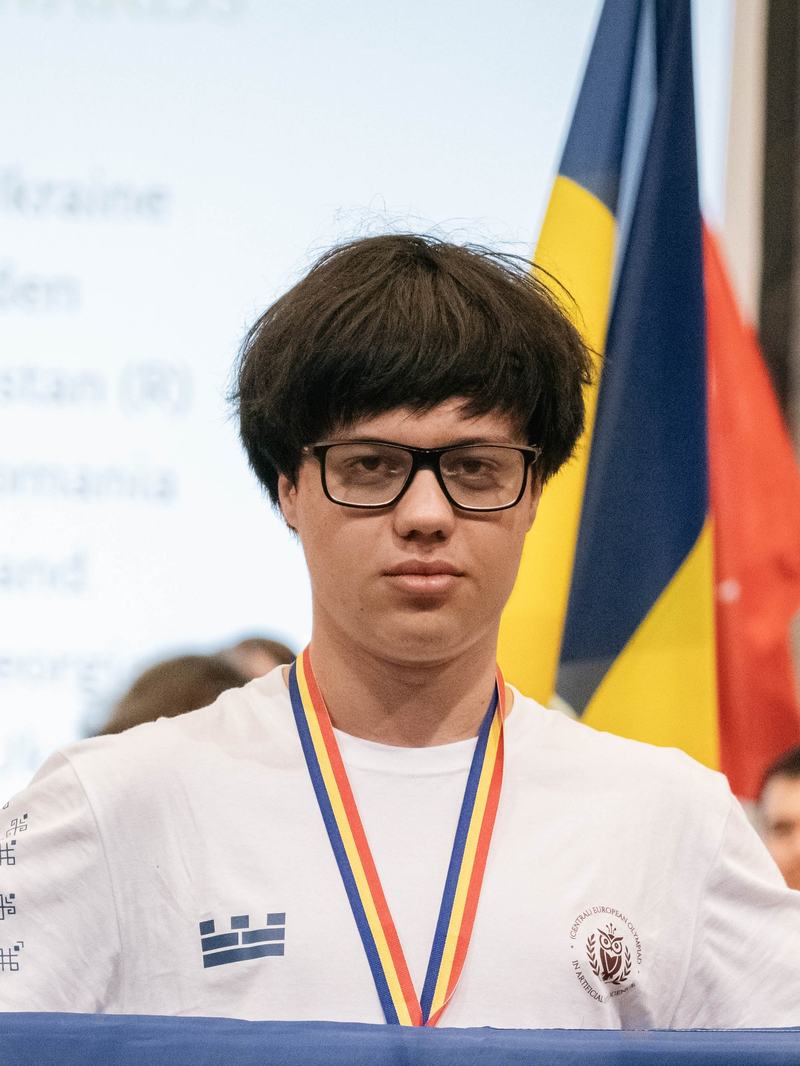
Roman Mielamud
“It turns out you can score 92 points without getting into the problems at all. That was one of the first moments when I understood how much strategy matters”Database →
- 🥇 Absolute winner of the European Olympiad in Artificial Intelligence 2026.
- 🥈 Silver medallist of the Balkan Olympiad in Informatics 2025 and the Baltic Olympiad in Informatics 2026.
- 🥉 Bronze medallist of the International Artificial Intelligence Olympiad (IAIO) 2026.
- 🏆 Two-time winner of the Ukrainian Olympiad in Artificial Intelligence 2025, 2026.
- 🥇 Gold medallist of the Ukrainian Olympiad in Informatics 2026.
How did you first realise that programming interested you?
When I was nine, my mum signed me up for a Scratch course, just to try it. At the presentation of the final projects there was also a presentation of projects from the HTML and CSS course. I liked that course too, so I signed up for it. After that I mostly did web development: I took courses in Python, JavaScript, C# and so on, and built my own projects. I liked how you could make a complex application in a fairly short time. And then the olympiads began.
Do you remember your first olympiad? What do you remember most about it?
My first olympiad was the Ukrainian Olympiad in Informatics in 2024. On the whole, everything was very hard. One particular thing I remember is problem D on the second day, where I had a rather large solution: at one point there were 60 segment trees in it, and it did not pass. In the end I won a bronze medal.
What did your usual preparation look like? What was the hardest part of it, and how did you learn to deal with it?
At first there was no systematic plan. I went through the winter programming school of Odesa Mechnikov University, where all the basic algorithms were explained very well: DFS, segment tree and so on. That was enough for a bronze at the Ukrainian Olympiad. Then I tried studying with Valentyn Melnyk and with Andrii Popyk, again simply solving their homework. And after the Ukrainian Olympiad in 2025 I started solving the archives of existing olympiads, such as the IOI and the Baltic Olympiad. I found a site where the problems are sorted by difficulty and kept solving the ones in the range I needed. I would not say there were any particular difficulties; it just took a lot of time, but I found it.
Was there an olympiad after which you were most disappointed? What did it teach you?
Probably the Ukrainian Olympiad in Informatics in 2025, especially the first round. I thought I had been training all that time, even if with breaks, and still I scored very few points in the first round, 66. After that the Odesa team leader, Serhii Zhuk, showed me and a few others that, it turns out, you can score 92 points without getting into the problems at all. That was one of the first moments when I understood how much strategy matters.
Was there a moment when you realised: “I can do far more than I thought”?
Yes. For example, at the Balkan Olympiad in Informatics in 2025 I did so-so in the first round, and in the second it somehow worked out that I switched between problems perfectly, submitted partial solutions and moved from bronze to the first silver. I understood what that strategy should look like in practice. Back then it happened partly by chance, and later, for example at the Baltic Olympiad and at the AI olympiads, I tried to do it deliberately.
Was there a problem, in all your years of olympiads, that you still remember?
One of them is the one I have already mentioned, the hard problem from the Ukrainian Olympiad in Informatics in 2024. Another was at the Summer Computer School: find the number of permutations of length n with k inversions. It is interesting because there is a pile of mathematical transformations in it, while the final code is not that complicated. It is a great problem, and it stuck with me. In general I prefer hard problems with many transformations.
Who influenced you most along the way, and what exactly did you take from that person?
Probably Valentyn Melnyk most of all, because I studied with him the longest. He also advised me on strategy and gave me interesting problems to train on. The Odesa winter programming school, run by Oleksandr Antonenko, had an influence too: as I said, the fundamentals of algorithms were explained very well there. And at the Summer Computer School there was Stepan Simak; he was the one who told me that for training it is better to solve existing olympiads rather than, say, Codeforces, because the problems there are of a slightly different kind.
Tell us about your coach. Did he perhaps teach you something not directly related to programming?
At all the international olympiads I actually attended, we called each other almost straight after the rounds and went over what had gone well and what had not, in terms of strategy. Valentyn Melnyk supported me and tried to guide me, to build the strategy up and strengthen it.
Which olympiad skills help you in life today in completely unexpected ways?
One thing I have noticed: in any other tasks and competitions related to programming, because of my experience with olympiad problems I keep thinking about possible constraints, about what could go wrong. I also find it fairly easy to spot mistakes in code when it does not work, because I did that for olympiad problems. And, to some extent, strategy helps in other competitions as well.
If you were offered the chance to add one rule to how olympiads are run, what would it be?
I do not know whether it should be a permanent rule. Perhaps some additional contest or the second stage should be held so that the scoreboard is visible to everyone, so that people learn to switch between problems rather than trying to solve each one for a hundred points straight away.
What are you doing now, and what place does programming have in your life?
I am not actively competing right now, but I still take part in Eolymp contests, Weekend Practice for example, and try to write them regularly. I also take part in cybersecurity competitions.
What in your life today has nothing to do with programming but matters a lot to you: a hobby or a passion?
Almost everything is connected with programming. I have a dog, Nikki, and I walk him every day. But even on walks I often think about problems.
Do you see your future in programming? Perhaps you have a dream or an idea you would like to realise with technology?
Yes, of course. Specifically, it is AI. My goal is to learn more about AI at university, to understand why existing models work the way they do, and how neural architectures are created in the first place. That is what I want to research.
This year you were top-1 at the European Olympiad in Artificial Intelligence. Could you share your impressions? What did you feel when you realised you were first?
The table with approximate scores was available the whole time, so I simply watched where people were scoring points and tried to solve the same subtasks. When the contest ended I felt proud of myself, and that all of it had not been in vain.
Was there a moment when you wanted to leave olympiads? What kept you going?
Probably the closest I came was after this year’s IOI selection, when I did not qualify. After failing the IOI selection I switched over and started giving more time to the artificial intelligence olympiads. There were only two olympiads left, and I decided to go to them anyway, and won gold at both.
Which myth about olympiad programming would you like to debunk?
The first myth that comes to mind is that olympiads are of no use in real life. In ninety per cent of cases that may be true, but when they are needed, it is worth it.
Imagine yourself at the start of your olympiad path standing in front of you. What would you tell him? Some advice, perhaps, or words of support?
Closer to the olympiads themselves, I would advise him not to worry when something does not work out, not to try to solve problems for a hundred points on the first attempt, and to prepare more intensively: to look for problems from past olympiads and try to solve them.