
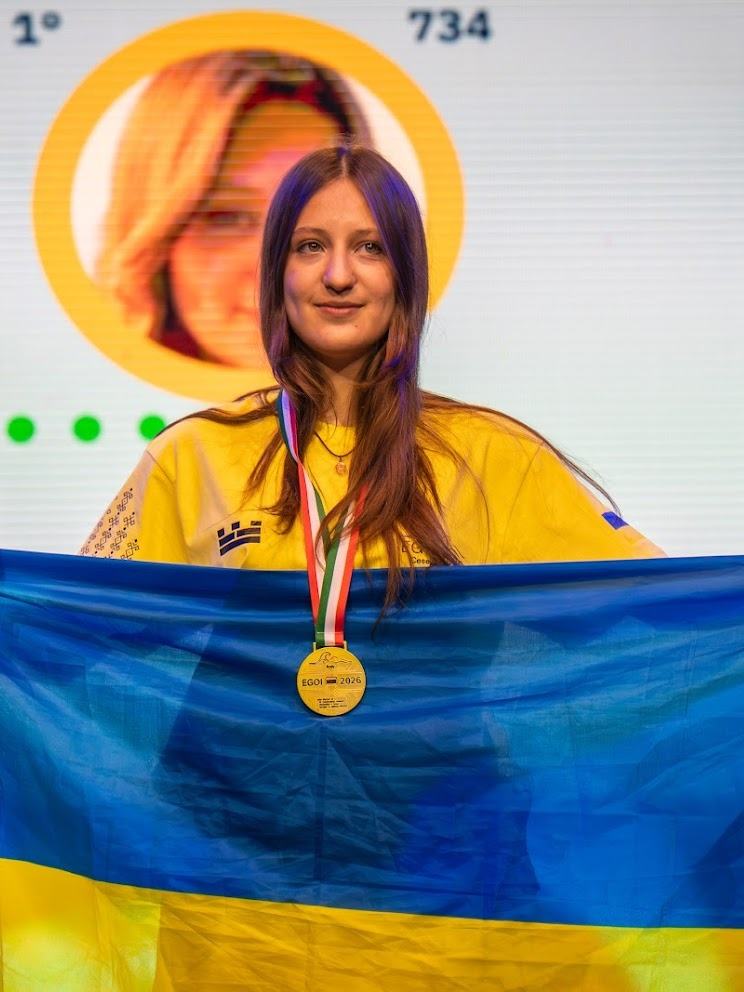
Daria Perekopska
“The main thing is to start, and then everything is not as difficult as it may seem”Database →
- 🥇 Absolute winner of the European Girls' Olympiad in Informatics 2026.
- 🥇 Gold medallist of the European Girls' Olympiad in Informatics 2024, the European Junior Olympiad in Informatics 2024 and the Ukrainian Olympiad in Informatics 2024, 2025, 2026.
- 🥈 Silver medallist of the International Olympiad in Informatics 2026, the Central European Olympiad in Informatics 2025 and the European Girls' Olympiad in Informatics 2025.
- 🥉 Bronze medallist of the International Olympiad in Informatics 2025, the Balkan Olympiad in Informatics 2025 and the European Girls' Mathematical Olympiad 2025.
- 🏆 Winner of the Ukrainian Girls' Olympiad in Informatics 2026.
When did you first realise you were interested in programming?
I started taking part in olympiads in the 8th grade, when I joined a new lyceum. I tried the lyceum round, as far as I remember, mostly because my parents told me to. Olympiads were already a big part of our family: my older brother Misha is a medallist of the Ukrainian and International Olympiads. Before that lyceum round he taught me the basics of C++ in a single evening, something like if statements and loops. Somehow, with just that knowledge, I made it to the Ukrainian Olympiad, where, by the way, I embarrassed myself badly. But the fact that things started working out almost right away is what gave me the drive to keep going.
Do you remember your first olympiad? What stayed with you most?
The first rounds I took were online, so I don't remember them much. But in April of the 8th grade I went to my first offline olympiad: the Ukrainian Junior and Girls' Olympiad in Informatics (UJGOI) in Krakow in 2023. I didn't win a single medal and barely solved one problem out of eight. But I came away with plenty of impressions, because I met great people who knew far more than I did back then. The atmosphere and the new friendships really motivated me.
That was also the year when Oleh Naver, Roman Yanushevskyi and Illia Denysiuk were studying at the Jagiellonian University: people I had only read about in the news. And then I arrived, and there they were, walking around and talking to the participants. I remember Roma Yanushevskyi telling us about some IOI problem in the lift, saying: "Come on, that's obvious." So I remember that olympiad very well: I still remember who I sat next to during the contest, and who I talked to and about what. And the funniest part is that I still hear about most of those people all the time, and some of them now even live in the same city as I do!
What did a typical period of preparation look like for you? What was the hardest part, and how did you learn to deal with it?
During the period when I was preparing actively, I had three sessions a week with my coach Valentyn Ivanovych Melnyk, that is, three contests, each of which took me about four hours. I also took part in rounds on various platforms and solved a lot of extra problems from different resources. It's hard for me to say how many hours a week I spent on preparation, but I remember times when I often stayed up until two or three in the morning...
I can't name any specific difficulties, but, as in anything, sometimes I definitely lacked personal discipline :)
Was there a moment when you realised: "I can do much more than I thought"?
Now there's a great story! After UJGOI in the 8th grade, which I already mentioned, I started preparing a lot. At first I didn't set myself any big goals and just solved as many problems as I could. Closer to winter I realised that I had a chance of making the EGOI and EJOI teams if I worked hard.
But then the Ukrainian Olympiad came: after the first round my result was mediocre, but after the second I unexpectedly made it into the top 10 and so qualified for the selection for the international olympiads. Everyone was shocked: me, my parents, and probably the other participants too. There was also a funny incident with accounts in the second round, but that's a different story.
A few months later the selection itself took place. I didn't expect anything better than last place in the IOI standings. But once again it somehow turned out that, by the sum of all the rounds, I was fifth, that is, the first one who doesn't make it. But I made the team for the Balkan Olympiad, which again surprised everyone.
To sum up, it was probably after these results, at the end of the 9th grade, that I understood I could compete for something bigger.
Was there an olympiad after which you were most disappointed? What did it teach you?
Given how many olympiads I've taken part in, quite a few of them went badly. The first that comes to mind is the Ukrainian Olympiad in 2025. My goal was to get into the top 6 and qualify for the Baltic Olympiad, and I felt quite confident. But I ended up in ninth place and didn't even qualify for the IOI selection, which was even more important.
What did this experience teach me? Probably the understanding that things don't always work out on the first try. But I should say that, by a stroke of luck, I did get to the selection that year, so now I can talk about it calmly.
Was there a problem during your whole olympiad journey that you remember even years later?
In fact, I remember many problems from different olympiads and training sessions. But the ones that stay with you best are probably those that strongly affected the result, positively or negatively.
For example, of the three EGOIs I took part in, at two of them I couldn't solve problem B of the second day. Although the problems there are sorted by difficulty, on problems C and D I ended up with more points than on B. They weren't hard problems, they just hit my weak spots, and the low scores for them strongly affected the result, because I lost about 70 points compared to the others.
After it happened for the second time, we started joking that it was my EGOI curse. So when I took part for the third time and finally overcame B2, the thought in my head was: "This can't be happening."
Who influenced you most during your olympiad journey, and what exactly did you take from that person?
I've met a great many wonderful people during my so-called "career", so it's hard to single out anyone in particular. Almost always they were older participants, lecturers at camps or team leaders at olympiads, who shared their experience, and not only olympiad experience.
Tell us about your coach. Maybe he taught you something that isn't directly about programming?
Yes, Valentyn Ivanovych Melnyk paid a lot of attention not only to problems and preparation, but also to our morale during an olympiad. Before every round we talked, he got us in the mood to win and advised us to sleep well and rest. In fact, these are just details and certainly not the only reasons for success, but they helped me get ready for the work and the result.
And in general I'd like to add that Valentyn Ivanovych is a very wise and interesting person. Over the years of his work he has collected so many interesting stories that he always has something to tell or use as an example. And one more thing: whatever the results, he always stressed that all these olympiads are far from the most important thing in life. That was sometimes hard to believe.
Which olympiad skills help you in life today in completely unexpected ways?
This is probably not exactly about olympiads, but for me personally it's connected with them. Over the last three years I haven't been home very often: constant trips, buses, trains, planes, all of it became the rhythm of my life. In those conditions I quickly learned to be more independent and organised. And in general I think this experience has had a big influence on me.
What do people usually not understand about informatics olympiads until they go through them themselves?
I think few people imagine at the start how close-knit this community is. At my first olympiads and camps I was amazed by how and why everyone knows everyone, or at least has heard of each other. And over the years it got even funnier, when international olympiads began and we started talking more with participants from other countries, because it turned out that everything is exactly the same there...
If you were offered to add one rule to the way olympiads are held, what would it be?
Oh, I don't know. Maybe something minimal, like not kicking the table of the person in front of you or not clicking a pen during a round.
But in general I've already mentioned the story with the Ukrainian Olympiad in 2024, when in the second round I was mistakenly given a different login and password for Eolymp. It was right after that story that new rules and a new login system appeared. So I can also consider myself slightly involved in creating them :)
What are you doing now, and what place does programming have in your life?
I'm just starting my first semester at university. I'm studying Computer Science, so all my subjects are in one way or another connected with informatics or mathematics. I'm not sure how much I will need specific olympiad knowledge, but in any case I'm glad to try and learn something new, especially something more applied.
What in your life today has nothing to do with programming but is very important to you? Maybe a hobby or a passion?
I've been dancing for many years. For the last eight years it was folk dance: Ukrainian and of other nationalities. When I started with olympiads, dancing became a kind of rest for me, a place where I didn't have to think about problems and contests.
At some point, when it became hard to combine programming and dancing, I decided to quit dancing, but a few months later I missed it and went back. Now, at university, I would like to keep dancing, but to try other styles.
Do you see your future in programming? Maybe you have a dream or an idea you would like to realise with technology?
Yes, so far I think I haven't made a mistake with my choice of field, because I find it very interesting to study and learn new things in it. I don't have any specific ideas or projects yet. I would just like to find a specialisation that involves scientific and intellectual work and has a positive impact on society.
This year you took first place at the European Girls' Olympiad in Informatics. Could you share your impressions? What did you feel when you realised you were first?
Well, I should admit that first place at EGOI was my goal a year earlier too, in 2025. But then everything failed spectacularly: so much so that I didn't even win gold and finished, I think, 23rd overall.
So this year I had an inner wish to prove that last year was an exception and to show what I'm really capable of. The olympiad itself and the rounds went fairly calmly, but the problems were easier than in previous years, so by the end of a round it was hard for me to judge my result against the others.
But after each round I almost immediately ran to the team leaders, who were waiting outside and already knew the results. So I definitely won't forget for a long time how I ran and already saw their faces, from which I could tell the result, and then I just started jumping! A great many people congratulated me, which was also incredibly nice.
And there was a strange feeling during the awards ceremony, when I stood on the stage with the flag and the long applause rang out. At that moment I realised that my name would be engraved, at least a little, in the history of both EGOI and the Ukrainian olympiads. So, although it wasn't my last olympiad, I think it was a worthy final touch to my career.
Was there a moment when you wanted to leave olympiads? What kept you?
Probably the strongest such wish came right after the Ukrainian Olympiad in the 10th grade, when I didn't even manage to qualify for the IOI selection. Back then it felt like the end of the world, because I had been working towards it for quite a long time.
I was mentally more prepared to not make the four (the IOI team) at the selection than to not get to the selection at all. So two ideas were fighting in me then: either to give all this up, or to keep preparing and try again a year later. I'm not sure I would have had enough drive for the second option.
But a miracle happened and I did get to the selection. That left me no choice but to go back to intense preparation, because there was about a month left until the selection and I was not ready to lose my chance once again.
Which myth about competitive programming would you like to dispel?
The first thing that comes to mind is that many people think that to get to the International Olympiad you have to be a genius, have been doing it since primary school and give up hobbies and free time.
Three years ago I couldn't even dream about the International Olympiad, because it seemed unreachable, but two years later I managed to make the team. So the main thing is to start, and then everything is not as difficult as it may seem.
Also, speaking of the community, it doesn't match the stereotypes about olympiad participants or maths-school kids at all. (Almost) everyone has a personal life and hobbies.
Imagine you meet yourself at the beginning of your olympiad journey. What would you tell her? Maybe some advice or words of support?
Probably I would tell her that all this will go much further than she thinks. I could never have imagined that most of my friends and acquaintances would be connected with olympiads, and that they would be from different cities and countries. I would never have believed what opportunities all this would open up for me, especially regarding university.
I think if I had known this at the beginning, I would have had even more motivation and ambition.