
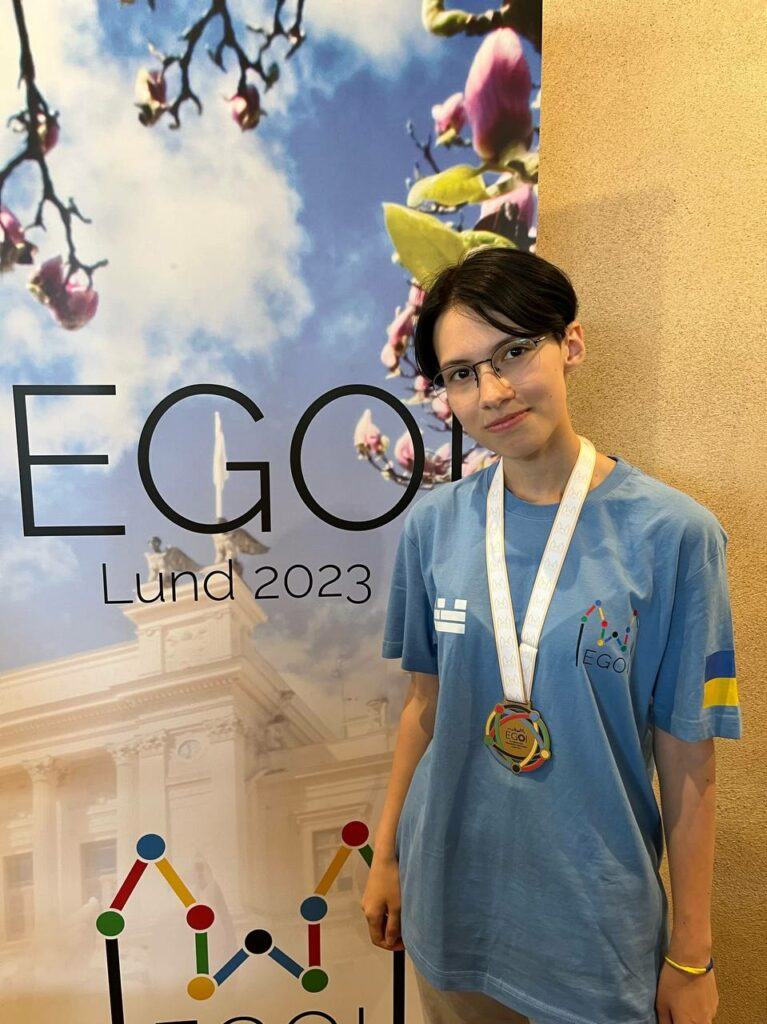
Daryna Kerpenko
“I did not prepare for any particular Olympics, I prepared for all at the same time”Database →
- Two-time bronze medalist of the International Olympiad in Informatics 2022, 2023.
- Three-time gold medalist of the European Girls' Olympiad in Informatics 2021-2023.
- One of the most titled girls at the European Girls' Olympiad in Informatics.
- Winner of the Ukrainian Olympiad in Informatics 2023.
- Two-time winner of the Ukrainian Girls' Olympiad in Informatics 2021, 2023.
- The winner of the Ukrainian Junior Olympiad in Informatics 2021.
When exactly did your interest in informatics and programming appear? Why these subjects in particular?
My interest appeared somewhere around 2nd grade. I really liked informatics, and the Scratch programming we were learning at the time, and from 6th grade I started doing more programming. First I learned Python, and then I was sent to Andrii Popyk (ed. — an olympiad programming coach from Khmelnytskyi) and I was already doing olympiad programming in C++.
How did you find out about the informatics olympiads? Do you remember your first olympiad?
I found out about the informatics olympiads from Andrii Popyk; my maths teacher saw my interest in programming and brought me to him. After that we prepared for the olympiads together.
My first olympiad was the city programming olympiad, in 7th grade. I did quite well then, and after that my interest in the olympiads grew even stronger.
How did you prepare for the olympiads, how much time did it take? What did your preparation and your goal look like?
I did not prepare for any one particular olympiad, I prepared for all of them at once. And from 9th grade onwards I usually worked from sites that had archives of olympiads, or from Codeforces.
Which matters more to you — taking part or winning? How do you take defeats?
Up to a certain stage, winning, so as to go further. And after that, whatever happens, happens.
How I react to a defeat depends on how much I invested emotionally in preparing for the olympiad. That is, the more effort I put in, the more upset I was if something went wrong.
Do you have your own formula for success, or a motto?
At the selections for the International Olympiad in 10th grade we worked out that you need a week's rest before an olympiad, and then everything will be fine. Because when you revise a lot right before an olympiad, you arrive and see those problems everywhere.
Which competition was the most important and instructive for you? Why?
In 9th grade, the European Girls' Olympiad in Informatics, because it was my first olympiad not for Khmelnytskyi or the Khmelnytskyi region but for the Ukrainian team.
Do you have a favourite type of problem that you recognise straight away and know exactly how to solve?
I like problems on data structures, and especially on the treap.
Which problems were the most interesting, and at which olympiad?
For some reason I remember the worst olympiads, the ones with geometry and circles. It is not the best thing, but it stayed with me for a long time.
If you were offered the chance to add one rule to how an olympiad is run, what would it be?
Probably everything is already fine as far as the rules go; how people follow those rules is another matter.
What are you doing now — studying, working?
Right now I am in my first year at the Jagiellonian University, and I am not working anywhere yet.
Does olympiad experience help you in your studies? In what way?
Yes, of course it helps. I did not have to learn programming from scratch, only to fill in what I did not know before. Solving programming problems is much easier for me now.
Did you ever want to stop doing programming? If so, what motivated you to carry on?
No, that never happened once.
Tell us about your coach — how exactly did he help you: only with the teaching, or with life advice too?
He gave me the foundation I moved on from. He gave me a name in Khmelnytskyi. He also found sponsors for us and paid for our entry to some olympiads. RMI, for example.
How do you rest, do you have any hobbies besides programming?
Of course I do. I draw in a realist style, watch all sorts of films and play games.
What would you advise students who are only just starting out in programming?
I am thinking about that very question. I started doing programming with my younger sister. Probably, push through the first steps, when nothing is working out for you. Because once you have achieved something, even at a school olympiad, you have more motivation, and until that moment you do not know what you are doing it all for. So probably: do not give up after the first failure.
What interesting story can you recall from olympiad life?
There were a lot of stories. What stayed with me most is how, after the closing of an olympiad, we would gather in someone's room and just talk and play games — it had a really good vibe.