
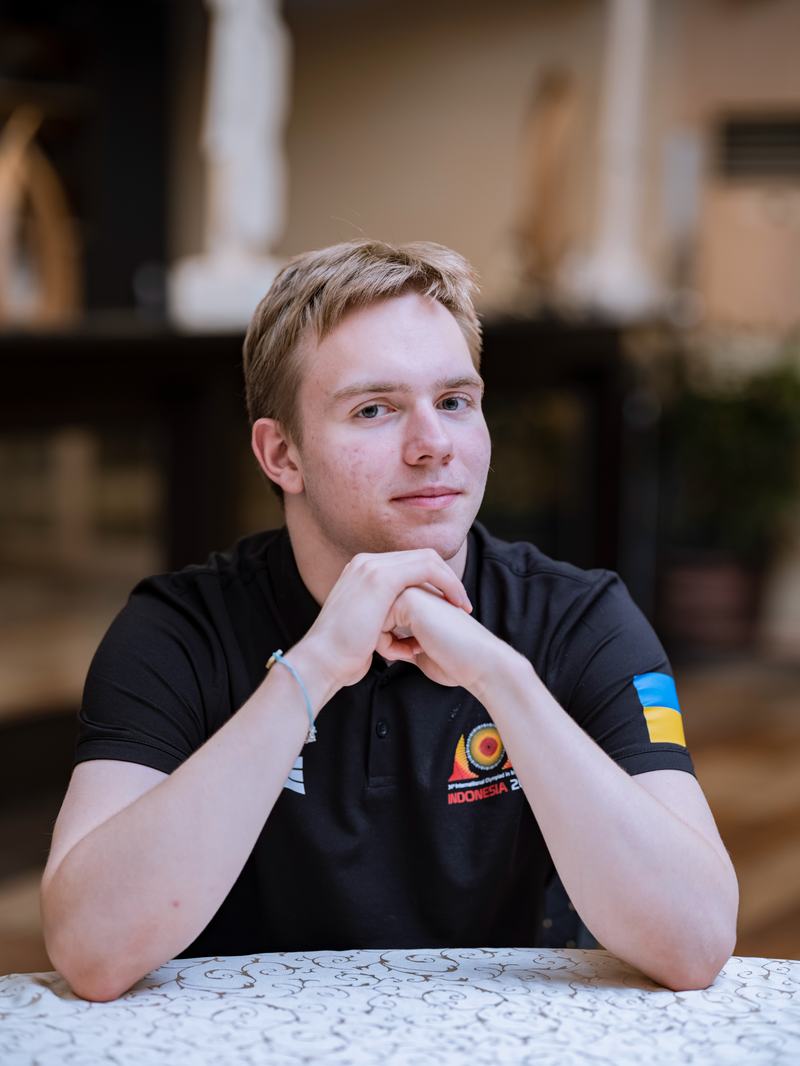
Oleh Naver
“The formula for success, in my opinion, is very simple and the same for many disciplines. Success = talent * diligence”Database →
- Two-time gold medalist 2021, 2022 and silver medalist 2020 of the International Olympiad in Informatics.
- The most titled Ukrainian at the International Olympiad in Informatics.
- Absolute winner of the European Junior Olympiad in Informatics 2020.
- Three-time gold medalist of the Ukrainian Olympiad in Informatics 2019-2021.
When exactly did your interest in informatics and programming appear? Why these subjects in particular?
My interest in programming appeared in sixth grade, when for no particular reason I started learning my first programming language — Pascal.
How did you find out about the informatics olympiads? Do you remember your first olympiad?
My first informatics olympiad was the Uzhhorod city olympiad in 7th grade, where I was sent because my form teacher knew I could program a little. To my surprise I won it; the competition among seventh-graders was not strong.
How did you prepare for the olympiads, how much time did it take? What did your preparation and your goal look like?
I started preparing for the olympiads seriously in 8th grade. Over time I began spending more and more time on it. I prepared very seriously for the Ukrainian Olympiad in Informatics 2019, hoping for a high result. I re-solved a lot of old problems from Ukrainian olympiads back then. At the time I did not yet know that 2019 would not resemble the previous year (ed. — in 2019 the difficulty of the final-stage problems was changed).
Which matters more to you — taking part or winning? How do you take defeats?
That is a very interesting question, because just as there is no winning without taking part, there is no taking part without winning — to sit the olympiads you first have to be selected for them. I definitely enjoyed taking part, and winning too, of course. But I am not sure I would have carried on doing programming actively if I had not been getting high results. Most likely in that case I would have done maths olympiads at school.
Do you have your own formula for success, or a motto?
The formula for success, in my view, is very simple, and the same across many disciplines. Success = talent * diligence. Talent with zero effort is still zero, and so is effort with zero talent. To achieve high results you need both.
Which competition was the most important and instructive for you? Why?
No contest here — UCPC 2021. There is a lot that could be said about that competition, but in short, it began as badly as you can possibly imagine, and thanks to our team's nerves of steel and luck that nobody would believe if it had not actually happened, we managed to win.
Do you have a favourite type of problem that you recognise straight away and know exactly how to solve?
I do have a favourite type — combinatorics. Knowing the solution to every problem of that type straight away is obviously impossible. But I do know straight away that I am going to like the problem, which improves the chances of solving it.
Which problems were the most interesting, and at which olympiad?
In the first round of the International Olympiad 2020 there was an interesting problem which unfortunately I did not manage to submit during the contest, even though I did come up with the right solution in time. After the contest it turned out that this problem was the hardest one there.
If you were offered the chance to add one rule to how an olympiad is run, what would it be?
For school olympiads I would definitely add the ability for participants to see the results during the round. In my view that makes the whole thing far more interesting, and it also reduces the chance of a participant misjudging the difficulty of the problems and spending all their time on the hardest one.
What are you doing now — studying, working?
At the moment I am studying at the National University of Singapore, and I do a little work on the side teaching programming.
Does olympiad experience help you in your studies or your work? In what way?
For teaching programming it definitely helps. As for everything else I am not sure, since I do not know what things would have been like if I had not done the olympiads. From my own experience I can say that there is a correlation between success in study or work and doing olympiads, but perhaps that is because the qualities that help in the olympiads also help in life.
Where do you see yourself in the future, what position would you like and where?
The world is changing so fast that it is hard to plan that far ahead. But I hope my skill set will be needed in the future.
Did you ever want to stop doing programming? If so, what motivated you to carry on?
In my school years there was no such wish, because there were always competitions or camps that added motivation. Now I am not sure whether you can say I still do olympiads, since I hardly spend any time preparing, though from time to time I take part in online competitions.
Tell us about your coach — how exactly did he help you: only with the teaching, or with life advice too?
Before moving to Kremenchuk I was coached by Oleksandr Volodymyrovych Mitsa (ed. — an olympiad programming coach from Uzhhorod) and Serhii Dmytrovych Vapnichnyi (ed. — an olympiad programming coach from Uzhhorod). After that, by Valentyn Ivanovych Melnyk (ed. — an olympiad programming coach from Kremenchuk). In my view the main role of an olympiad programming coach is to build a strong olympiad community around themselves, and my coaches were extraordinarily good at that.
How do you rest, do you have any hobbies besides programming?
I play chess and table tennis, and I am fond of swimming.
What would you advise students who are only just starting out in programming?
My main piece of advice for every olympiad competitor is to believe in yourself. In my view, not believing in yourself enough is one of the main causes of failure at the olympiads. It is hard to win if you start competing under the motto "You are all winners already". You have to believe in winning, because there is always a chance, however small. So do not take it away from yourself. Everyone has their own limit, but you will never find out where yours is without trying to reach it.