
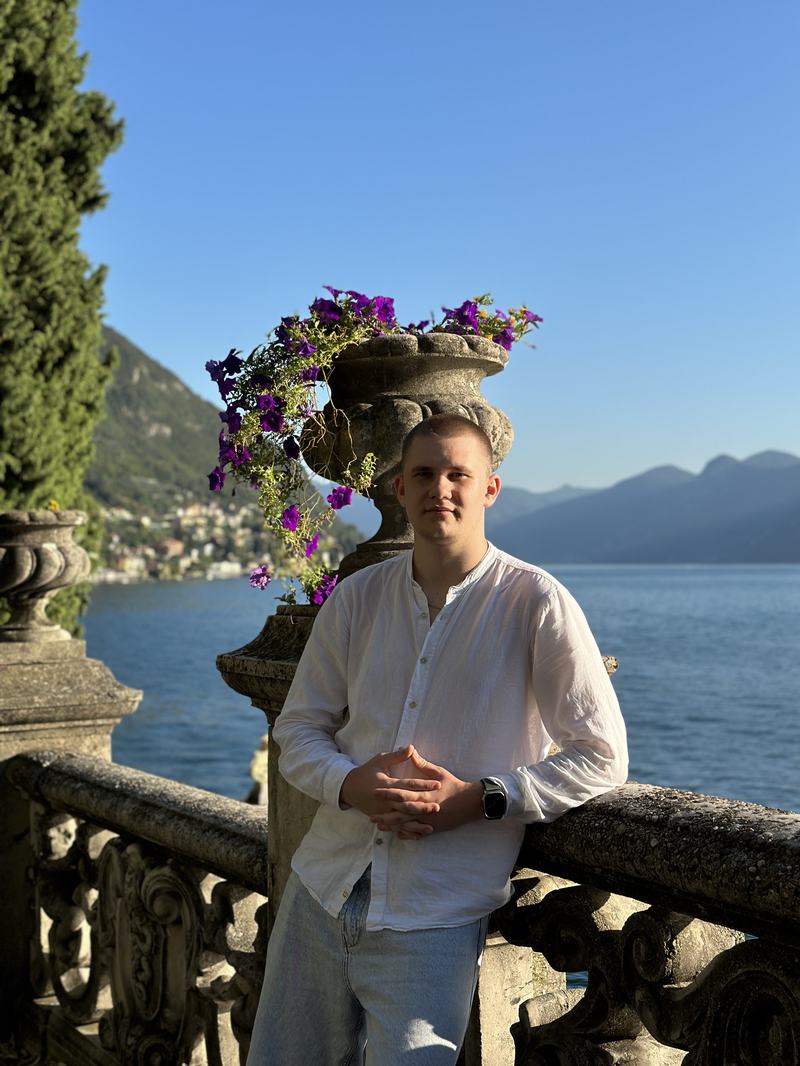
Nazarii Denha
“Olympic experience helps to find a job. After all, employers see that you have success and this is already a big plus for most”Database →
- Gold medalist of the International Olympiad in Informatics 2019.
- Four-time gold medalist of the Ukrainian Olympiad in Informatics.
When exactly did your interest in informatics and programming appear? Why these subjects in particular?
My interest appeared when we were starting to study informatics at school; we did «Steps to Informatics», there was a game like that, and then there was Scratch.
More generally, both my parents are maths teachers, and from about 4th grade they sent me to classes with Valentyn Ivanovych Melnyk (ed. — an olympiad programming coach from Kremenchuk), and after that the interest simply continued. So it was not that I sat down and decided I needed to start doing informatics — that is just how it worked out.
How did you find out about the informatics olympiads? Do you remember your first olympiad?
From the moment I started studying with Valentyn Ivanovych, it was olympiad programming straight away. For about six months I did basic things: drawing something, then in the Pascal programming language, and after that we started learning various mathematical operations, and then I began preparing for my first city informatics olympiad.
How did you prepare for the olympiads, how much time did it take? What did your preparation look like?
I think the same as everyone: you just solve problems on various sites, or work through old olympiads of any level and any country. Besides that, a few times a year you go to preparatory schools where you study particular algorithms. On ordinary working days I spent at least 3 hours a day preparing. But when there was a computer school or a preparation marathon before an olympiad, that was at least 5 hours a day of contest alone plus another 1 or 2 hours of upsolving — so it was almost a full working day, even back then.
Which matters more to you — taking part or winning? How do you take defeats?
As the saying goes, «it is not the winning that matters but the taking part» — but all the same, when you win it is far better and more satisfying. On top of that, you understand that you have been chosen to represent Ukraine at the International Olympiad, or your region at the Ukrainian Olympiad, so you are aware that a good result is expected of you. So of course winning is better than merely taking part. But if a defeat has happened, the best thing is to work out exactly what did not go right for you, so as not to repeat the mistake next time.
Which competition was the most important and instructive for you? Why?
When I was at the International Olympiad for the first time in 9th grade (ed. — 2017, Iran), I did not manage to win even a bronze medal, and after that I analysed how those 5 hours allotted for the olympiad had gone for me overall. I understood some basic mistakes — that I manage my time badly during an olympiad, that I was doing some other things badly — I analysed it and remembered it. And even if I had done that analysis just one day before that olympiad and understood it, I would most likely have managed to take some medal. So after that olympiad I changed my approach to competing a great deal.
Do you have a favourite type of problem that you recognise straight away and know exactly how to solve?
If I recognise the solution straight away, it means I have simply seen a problem like it and solved it at some point. I do not like problems where something is just stated and you have to take some heavy algorithm, write it out and that is that — where you do not even have to think. Ideally it should not be some treap, or a simple DFS; I prefer it to be an algorithm. That is, I like problems that need some interesting, clever algorithm for lifting or for bitmasks, but where you also have to work out how to apply it in that particular problem — a mixture of constructive work and interesting algorithms.
If you were offered the chance to add one rule to how an olympiad is run, what would it be?
All the rules have been worked out over years for different kinds of competition, for university students and for school students, and different stages have different rules too, so I think it is already planned well enough and there is nothing left to change. The one thing I would point to is that at the Ukrainian and regional stages the problems are always in order of difficulty — the first is the easiest and so on. At international and European olympiads, or at the selections, it is not like that. It seems to me that this would be better changed in the Ukrainian competitions, so that participants do not get used to the first problem being the easiest. But that is a small thing.
What are you doing now — studying, working?
I have been working at Scroll for two years now. We build a second-layer blockchain on top of Ethereum, so we have a lot of mathematics in what we do, various cryptographic schemes, and also a lot of interesting technology such as distributed systems and the like. I have already finished studying.
Does olympiad experience help you in your work? In what way?
Olympiad experience helps you find work in the first place. Because during most job interviews employers see that you have some achievements, and for most of them that is already a big plus. Besides that, you may be asked something about yourself so they can see your character and build a picture of you. Interviews often take an interest in how you think, and there are problems very similar to olympiad ones. I said earlier about the ability to think, about constructive problems — that, it seems to me, helped; you do not see it plainly, but it helps, it gets used unconsciously in your head.
Where do you see yourself in the future, what position would you like and where?
I have not really thought about it; I never think many years ahead. I have various ideas, but I cannot say concretely that I want to be a team lead, or that I want to start my own company in some field, or anything like that.
Did you ever want to stop doing programming? If so, what motivated you to carry on?
I think not — that wish might arise for 30 seconds and vanish straight away.
Tell us about your coach — how exactly did he help you: only with the teaching, or with life advice too?
On the teaching and olympiad preparation side, he was always trying to come up with new training camps, looking for different contests, and if you were being very lazy or doing nothing he could make you, or motivate you, to start doing something. On life advice: before an olympiad the coach would sometimes invite a psychologist to work with the children. We could also meet the coach in an informal setting — not where he is the coach and we are the students — for example, after an olympiad we would grill some shashlik and talk about various situations, to keep the team's spirits up.
How do you rest, do you have any hobbies besides programming?
From my first or second year at university I started taking an interest in cars and motorsport, and everything connected with them. I loved sitting in some car park tinkering with a car, fixing something, installing something, fitting something extra. For a while now I have also been doing boxing and wrestling regularly. I like it a lot because it is a very motivating environment in which you improve your physical condition while also learning something new. Sometimes I play computer games; I might go to an internet café with friends to play Counter-Strike or Dota. So yes, sometimes I do things I find interesting that have nothing to do with programming, which has already become my job.
What would you advise students who are only just starting out in programming?
The most important piece of advice is that if something is not working out but you enjoy doing it, do not give up — because at some point you may rethink something and get much better results.
What interesting story can you recall from olympiad life?
If it is just the olympiad itself, that is not very interesting, because you sit for 5 hours and solve problems; the most interesting things usually happen outside the olympiad. When the olympiads are held in Ukraine, or at international competitions, you travel to some new city and go on an excursion there. Excursions in general, especially when there is a chance to see other countries, are the most interesting bonus of taking part in the olympiads.